

📖 ~18 min read
Every time you crack black pepper over a meal, you are unknowingly activating receptors in your immune system. Not metaphorically — literally. The compound responsible is β-caryophyllene (BCP), a sesquiterpene so structurally unusual that it behaves as both a terpene and a cannabinoid simultaneously. It is the only molecule in the plant kingdom confirmed to do this.
This is not a fringe finding. It was published in the Proceedings of the National Academy of Sciences (PNAS) in 2008 by Jürg Gertsch and colleagues at the Swiss Federal Institute of Technology. Their paper, “Beta-caryophyllene is a dietary cannabinoid,” changed how we understand terpenes in human health — and quietly upended some of the pharmaceutical industry’s assumptions about the endocannabinoid system.
Yet for all its extraordinary pharmacology, β-caryophyllene faces a problem almost nobody in the CBD industry talks about openly: it is thermally fragile, and most commercial extraction methods routinely expose it to temperatures that compromise or destroy its therapeutic potential.
Scientific publications on BCP’s neuroprotective role
Maximum BCP share of Cannabis sativa flower essential oil
CB2 receptor binding — confirmed full agonist activity
Year BCP confirmed as “dietary cannabinoid” (Gertsch et al., PNAS)
The Molecular Profile: What Makes BCP Structurally Unique
Before we can understand what β-caryophyllene does inside your body, we need to understand why it can do it. Most terpenes cannot interact with cannabinoid receptors because their molecular geometry does not fit the receptor’s binding pocket. BCP is the exception, and the reason comes down to a single architectural feature: an unusual cyclobutane ring.
β-Caryophyllene: Key Properties
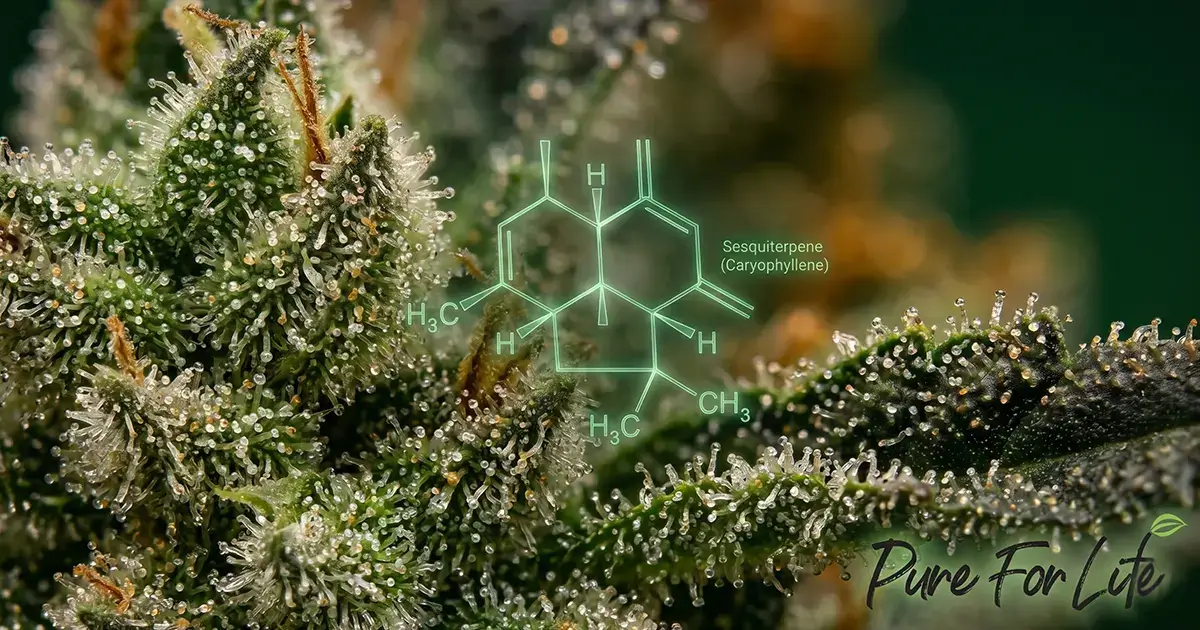
β-Caryophyllene is a sesquiterpene — built from three isoprene units (C₅), giving it the 15-carbon skeleton C₁₅H₂₄. Compare this to monoterpenes like limonene or myrcene, which only have ten carbons. That extra mass matters: BCP’s larger 3D structure allows it to fit into a receptor binding pocket that smaller terpenes simply cannot reach.
What makes BCP truly remarkable is that it contains a cyclobutane ring (a four-membered carbon ring) fused to a nine-membered macrocyclic ring with a trans-double bond — both features extraordinarily unusual in natural products. The ring strain from the cyclobutane forces the molecule into a specific 3D conformation, and it is exactly this conformation that allows BCP to slot into the CB2 cannabinoid receptor.
BCP’s biosynthesis begins from dimethylallyl pyrophosphate (DMAPP) and isopentenyl pyrophosphate (IPP). Sequential condensation yields farnesyl pyrophosphate (FPP), which undergoes enzyme-catalyzed intramolecular cyclization via the QHS1 cyclase to produce the final bicyclic structure. This enzymatic precision is partly why the natural (−)-enantiomer may exhibit different receptor binding characteristics than a synthetically reconstructed molecule.
The CB2 Receptor: Your Immune System’s Hidden Switch
Most people who have heard of the endocannabinoid system know about CB1 — the receptor THC binds to, producing psychoactive effects primarily in the brain. But there is a second cannabinoid receptor, CB2, that operates almost entirely outside the central nervous system, with arguably more significant implications for everyday health.
CB2 receptors are expressed predominantly in:
- Immune cells — macrophages, T-cells, B-cells, natural killer cells, mast cells
- Peripheral nervous tissue — dorsal root ganglia (pain signaling nodes)
- Gastrointestinal tract — enteric neurons, intestinal immune tissue
- Liver, kidney, bone marrow — upregulated during tissue injury
- Skin keratinocytes and sebaceous glands — critical for topical applications
- Microglia — brain immune cells, strongly expressed during neuroinflammatory states
This distribution pattern tells a clear biological story: CB2 is a tissue protection and immune regulation receptor. When activated, it generally signals the body to reduce inflammatory cytokine production, dampen immune cell migration, decrease oxidative stress, and initiate tissue repair — all without intoxication, because CB2 is not expressed in the brain’s limbic reward pathways.
— Gertsch et al., 2008; ScienceDirect Topics pharmacology review
The table above highlights something important: CBD has weak direct binding to CB2. Its anti-inflammatory effects are largely indirect, operating through FAAH enzyme inhibition, TRPV1 channels, and other mechanisms. BCP, by contrast, is a full CB2 agonist — it binds directly, activates the receptor, and initiates the downstream signaling cascade. This is a pharmacologically meaningful distinction.
How BCP Docks to CB2: The Binding Mechanism
CB2 is a G protein-coupled receptor (GPCR) — a seven-transmembrane helix protein spanning the cell membrane. When BCP binds to its extracellular pocket, it causes a conformational change activating the Gᵢ/₀ protein complex, suppressing adenylyl cyclase and reducing cyclic AMP (cAMP). This triggers a cascade of downstream immune-modulatory effects.
CBN binds CB2 at Ki = 126.4 nM, and delta-9-THC at Ki = 36 nM. BCP (Ki = 155 nM) is not as potent as THC — but it is highly selective: it engages CB2 without triggering the CB1 activity that causes psychoactivity. Critically, animal research shows no tolerance develops to BCP’s CB2 agonism over extended use — a meaningful advantage for long-term inflammation management.
The NF-κB Cascade: Turning Off Inflammation at the Source
Nuclear Factor kappa B (NF-κB) is often called the “master regulator of inflammation.” It controls the expression of over 150 target genes. Under normal conditions it is held inactive by its inhibitor IκBα. When an inflammatory trigger arrives — via TLR4, oxidative stress, or physical injury — IκBα is degraded, NF-κB translocates to the nucleus, and begins transcribing: TNF-α, IL-1β, IL-6, COX-2, iNOS.
Chronic low-grade NF-κB activation — driven by modern diet, stress, and environmental toxins — is now recognized as a central mechanism in virtually every major chronic disease, from cardiovascular disease and type 2 diabetes to Alzheimer’s and cancer. This is where BCP performs its most clinically significant work.
A 2021 study in Frontiers in Pharmacology (Li et al.) demonstrated dual inhibition of NF-κB and the NLRP3 inflammasome in a gouty arthritis model, showing BCP “inhibited the expressions of NLRP3, Caspase-1, ASC, TLR4, MyD88, p65, and IL-1β.” BCP also activates the Nrf2/HO-1 antioxidant pathway, creating what researchers describe as a “bidirectional anti-inflammatory effect.”
Note: Representative averages. Individual study results vary by dose, model, and route.
Health Research: What the Science Actually Shows
Chronic Pain and Neuropathy
Animal studies show consistent analgesic effects through combined CB2, TRPV1, and PPARα activation. BCP’s multi-pathway pain relief means no single receptor is “flooded” — meaningful analgesia without receptor downregulation or tolerance development. Animal data shows no tolerance develops to BCP over extended use — a significant advantage over opioids and NSAID regimens.
Anxiety and Depression
A 2024 review in the International Journal of Molecular Sciences found BCP shows significant potential in emotional and cognitive disorders through CB2 modulation. CB2 receptors on microglia (brain immune cells) are strongly implicated in the neuroinflammation hypothesis of depression — and BCP’s ability to cross into central nervous tissue during neuroinflammatory states may explain why users report mood benefits at therapeutic doses.
Neuroprotection
A 2024 paper in Neurología demonstrated BCP inhibits blood-brain barrier permeability in a Parkinson’s disease model. A 2023 study in Brain Research showed BCP reduces microglial activation in aged mice undergoing surgical stress. Research in Molecules (2025) further characterizes BCP as a neuroprotective agent alongside xanthohumol.
Metabolic and Cardiovascular Health
A 2023 paper in ACS Pharmacology & Translational Science demonstrated BCP alleviates diabetic cardiomyopathy in mice by inhibiting oxidative stress and inflammation via CB2 activation — particularly relevant because diabetic cardiomyopathy involves exactly the NF-κB-driven inflammation that BCP directly counters.
As of 2025, BCP has been studied in models of: chronic pain, neuropathic pain, anxiety, depression, Alzheimer’s disease, Parkinson’s disease, multiple sclerosis, colitis, liver fibrosis, kidney disease, diabetic cardiomyopathy, osteoarthritis, gout, sleep deprivation cognitive impairment, and substance use disorder. More than 500 scientific publications have investigated BCP’s protective role. The breadth reflects the ubiquitous distribution of CB2 receptors — a genuinely systemic immune modulator with an extraordinary safety profile.
BCP in Food: Dietary Sources vs. Therapeutic Doses
BCP holds FDA GRAS (Generally Recognized As Safe) status and is present in numerous common foods — you are almost certainly consuming it every day. The honest question is: how much, and is it enough to produce the effects seen in research?
3.8–37.5%
~55% EO
High EO
Daily ~mg
Low
The dose reality: The amounts of BCP consumed through normal food use are likely sub-therapeutic for most health conditions. Research studies typically use 50–200 mg/kg in animal models. Cannabis — particularly certain high-BCP strains — provides the highest dietary source in any concentrated, accessible form. But only if the extraction process preserves it.
The Extraction Problem: Where BCP Disappears
Cannabis consumers and CBD users are routinely presented with marketing language about “full spectrum” and “broad spectrum” extracts. But being labeled full spectrum tells you nothing about whether the terpene fraction — including BCP — actually survived the extraction process intact. The thermal sensitivity of cannabis terpenes means many “full spectrum” products contain dramatically reduced terpene levels compared to the original plant.
Studies show terpene loss begins the moment cannabis is harvested. Without proper handling, up to 40% of a plant’s terpene content can be lost within the first week (LabDepot, 2025). The degradation problem often begins before extraction even starts — making the extraction method choice all the more critical.
Why BCP Is Particularly Vulnerable
BCP’s vapor pressure — the rate at which it transitions from liquid to gas — is non-trivial even at temperatures well below its nominal boiling point (~119–130°C). During commercial extraction runs at elevated temperatures, BCP volatilizes continuously throughout the process. Post-extraction steps — winterization, filtration, decarboxylation, solvent recovery — each add cumulative thermal load to the terpene fraction.
Terpene Survival Rates: A Method-by-Method Analysis
Moderate
Low retention
Illustrative estimates based on process temperature profiles.
Method 1: Supercritical CO₂ Extraction
Most commercial CO₂ runs at 40–60°C+ at 200–400 bar. These conditions significantly alter terpene vapor-liquid equilibrium. Co-extraction of waxes and lipids necessitates winterization (–40°C), filtration, and re-heating — each step further depleting the intact terpene profile. The result is a cannabinoid-rich extract with a compressed terpene fraction.
Method 2: Ethanol (EtOH) Extraction
Ethanol is a powerful polar solvent that co-extracts chlorophyll, waxes, and pigments alongside cannabinoids and terpenes. The critical vulnerability is solvent removal: terpenes co-evaporate alongside ethanol during rotary evaporation at 35–60°C. As the technical literature confirms: “Terpenes are highly volatile — many evaporate along with ethanol, resulting in considerable loss.” This is not incidental; it is a fundamental thermodynamic consequence of the method.
Method 3: Low-Pressure Aerosol Extraction (R134a / LPE)
Low-pressure aerosol extraction — pioneered commercially by PURE5™ Extraction using R134a — operates at room temperature and low pressure. R134a has a boiling point of –26.3°C, meaning it naturally volatilizes at ambient conditions after extraction, leaving behind the intact terpene-rich oil without any thermal solvent removal step. Because the system never exceeds room temperature, BCP and the complete terpene complement experience zero thermal stress throughout the process. The result is what the PURE5™ process specifically delivers: a High Terpene Extraction (HTE) — a full-spectrum, strain-specific extract where the terpene profile mirrors the original plant as closely as commercial technology allows.
The defining variable in terpene preservation is the thermal load experienced by the extract during and after extraction. Any process requiring heat for solvent removal necessarily sacrifices terpene integrity. A process that operates and recovers its solvent at room temperature does not impose this trade-off. This is not a marketing claim — it is straightforward vapor-pressure physics.
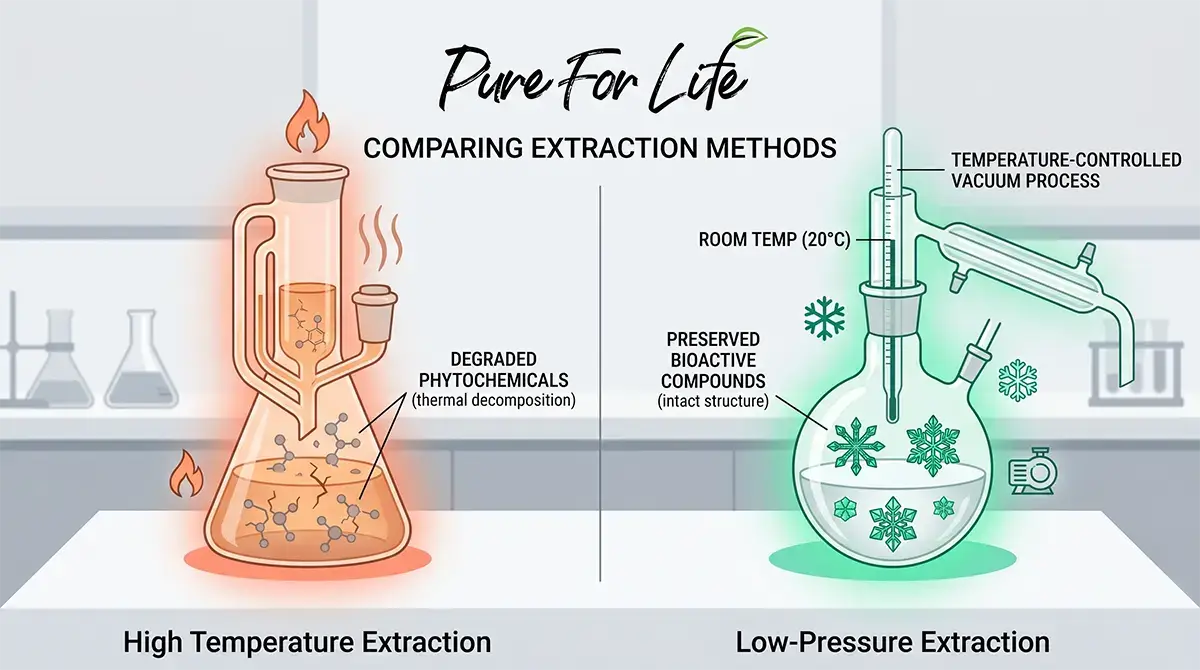
High Temperature vs. Low-Pressure Extraction:
Heat-based methods cause thermal decomposition of beta-caryophyllene and
other terpenes. The PURE5™ low-pressure process operates at room temperature
(20°C), preserving the intact bioactive compound structure.
Original Analysis: The Dietary Cannabinoid Gap
Here is a synthesis framed in a way not yet published anywhere in industry analysis or academic review. We call it the Dietary Cannabinoid Gap, and we believe it represents one of the most underappreciated issues in modern wellness science.
The Argument
Human beings evolved eating a diet rich in BCP. Traditional cuisines worldwide — Mediterranean, South Asian, Latin American, Middle Eastern — feature daily use of black pepper, cloves, rosemary, oregano, and cinnamon. These foods provided consistent low-level CB2 stimulation throughout the day. The ancestral gut microbiome, with its rich diversity, amplified this exposure further.
Modern industrial food processing has progressively stripped BCP from the diet. Spices are heat-processed, irradiated, or oxidized before packaging. The average Western diet’s reliance on ultra-processed foods contains essentially no intact terpenes of any kind.
We propose that the epidemic of chronic low-grade inflammation observed across modern populations is partially a consequence of “CB2 tonic underactivation” — a state in which the immune system’s primary molecular brake pedal (CB2 signaling) is chronically under-stimulated due to the near-complete removal of dietary BCP from the modern diet.
This framework is consistent with Dr. Ethan Russo’s Clinical Endocannabinoid Deficiency (CECD) hypothesis and extends it specifically to the dietary terpene dimension. The most effective intervention is not high-dose CBD supplementation in isolation, but restoration of the complete phytocannabinoid-terpene matrix that evolved alongside human consumption patterns.
What to Look For When Choosing a Product
- Full terpene panel on the CoA — not just cannabinoids. A CoA listing only CBD, THC, and minors tells you nothing about terpene content.
- Strain specificity — high-BCP strains (OG Kush, Sour Diesel, Chemdawg, Bubba Kush) should be identified in the product description.
- Extraction method and process temperature — a reputable producer should confirm the thermal profile their extract experienced.
- “Live resin” or “low-pressure extraction” on the label is a positive signal — verify with the manufacturer.
- Aroma is a useful proxy — a BCP-rich extract from a peppery strain should smell distinctly peppery and earthy. An odorless “full spectrum” product has almost certainly had its terpene fraction compromised.
The Bottom Line
β-Caryophyllene may be the most important molecule in the cannabis plant for anyone interested primarily in its anti-inflammatory and immune-modulating properties. It is the only dietary compound that directly activates the CB2 receptor, without any psychotropic liability whatsoever.
The tragedy is that BCP is also the most thermally vulnerable compound in the extraction workflow. By the time many commercial extracts reach the shelf, the very molecule responsible for some of the most clinically significant effects has been driven off by process heat — leaving a product rich in cannabinoids but depleted of the terpene that gives those cannabinoids their full immunological context.
The solution is neither exotic nor expensive. It is a matter of extraction physics: keep temperatures low, keep pressures manageable, and let the chemistry do the work it evolved to do. Every pepper you grind fresh over your food is a reminder that this molecule is already part of your biology. The question is whether the cannabis products you choose are delivering it intact.
Key References & Further Reading
- Gertsch J. et al. “Beta-caryophyllene is a dietary cannabinoid.” PNAS. 2008. doi:10.1073/pnas.0803601105
- Li W-Y. et al. “β-Caryophyllene ameliorates gouty arthritis via NLRP3 and NF-κB inhibition.” Front. Pharmacol. 2021. doi:10.3389/fphar.2021.651305
- Hashiesh H.M. et al. “CB2-selective pharmacological properties of β-caryophyllene.” Biomed. Pharmacother. 2021. PMID: 34091179
- “BCP, a CB2 Selective Agonist, in Emotional and Cognitive Disorders.” Int. J. Mol. Sci. 2024. doi:10.3390/ijms25063203
- Ojha S. et al. “BCP alleviates diabetic cardiomyopathy via CB2 activation.” ACS Pharmacol. Transl. Sci. 2023. doi:10.1021/acsptsci.3c00027
- Venkatakrishna K. et al. “Viphyllin exerts antinociceptive effects via CB2, PPARα and TRPV1.” J. Pain Research. 2022.
- Molecules. “BCP and Xanthohumol as Neuroprotective Agents.” 2025;30(18):3702.
- PURE5™ Extraction. “Terpene Extraction Without Degradation.” 2025. pure5extraction.com
- Pure For Life. “Maximizing CBD Bioavailability.” pureforlife.com
- ScienceDirect. “Caryophyllene pharmacology review.” sciencedirect.com